Vox AC15 vs AC30 Hand-Wired: Which Amp Should You Buy?
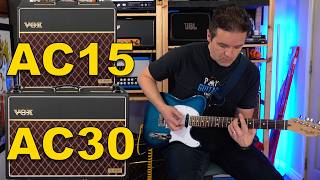
Same circuit family, same Celestion Alnico Blue speakers, same controls. One has twice the power and an extra speaker. Landon put the AC15 and AC30 Hand-Wired side by side, switched between them in real time, and took them from clean to fully maxed out.
The Specs Side by Side
- Output
- 15 watts
- Power tubes
- 2 x EL84
- Rectifier
- GZ34
- Speaker
- 1 x 12" Alnico Blue
- Normal channel
- Bright + Boost
- Reverb / FX loop
- Spring / Yes
- Output
- 30 watts
- Power tubes
- 4 x EL84
- Rectifier
- GZ34
- Speakers
- 2 x 12" Alnico Blue
- Normal channel
- Bright
- Reverb / FX loop
- Spring / Yes
Same Speakers, Twice the Power
On paper these two are about as close as two amps get. Both have a Normal channel and a Top Boost channel, tube-driven spring reverb, an effects loop, a master Tone Cut and a master Volume, and both run a GZ34 rectifier into Celestion Alnico Blue speakers.
The AC15 sends its 15 watts to one speaker. The AC30 splits 30 watts across two. So both amps are pushing their speakers equally hard, and the difference you hear comes from the second speaker, the bigger power section and the much bigger cabinet.
The one feature the AC15 has that the AC30 doesn't is a Boost switch on the Normal channel, which gives that lower-gain channel a useful kick. The AC30 also weighs about 70 lb, which matters a lot more than you'd think if you're carrying it to gigs.
How They Were Tested
Both amps were miked with Beyerdynamic TGi51 dynamic mics, set up the same way just off the dust cap. On the AC30, only one speaker was miked so it's a fair fight against the AC15's single speaker. Landon switched between the two with a Radial BigShot ABY, playing his 1992 Fender Telecaster Plus, with the EQ at noon and the volumes matched so the louder amp doesn't win just for being louder.
Clean Tones 2:28
Both amps start clean on the Top Boost channel with no reverb. This is the classic Vox chime, and it's where you first hear the AC30's bigger cabinet and second speaker show up in the low end and the width of the sound.
Edge of Breakup 3:30
Next, both amps get pushed to the point where they're clean when you play soft and gritty when you dig in. Watch the knob positions on screen. Since the AC15 has half the power, it reaches breakup at a much lower volume, which is exactly why so many people love it at home and in the studio.
Dirty Tones and Maxed Out 5:50
Then it's time to turn them up. Each amp gets cranked, then both are run fully maxed, and finally both amps play together. This is where the 1x12 and the 2x12 really separate when they're working hard.
Which One Should You Buy?
- You mostly play at home or record
- You want breakup at lower volumes
- You play smaller rooms and gigs
- You'd rather not carry 70 lb
- You play with a loud drummer
- You want more clean headroom
- You love the wide sound of a 2x12
- You use it as a clean pedal platform
If Landon could only keep one, it's the AC30. Watch his thoughts at 6:52 to hear why.
Common Questions
Is the AC30 twice as loud as the AC15?
No. Doubling the power adds roughly 3 dB, which you hear as a noticeable step up but nowhere near twice as loud. The AC30's second speaker moves more air too, so in a room it feels bigger and louder than the wattage alone suggests.
Is the AC15 loud enough to gig with?
For a lot of players, yes, especially in smaller venues or when the amp is miked through the PA. With a loud drummer and no PA support, the AC30's extra headroom makes life easier.
Do both amps have reverb and an effects loop?
Yes. Both have tube-driven spring reverb with Tone and Level controls, plus an effects loop.
What speakers do they use?
Both use Celestion Alnico Blue speakers: one in the AC15, two in the AC30. The Blue is rated at 15 watts, which is why each amp pushes its speakers equally hard.
Which one is better for recording?
The AC15. It reaches that pushed, touch-sensitive sound at a lower volume, which is much easier to work with in a home studio.
Gear in This Video
The Full Vox Hand-Wired Series



More From the Blog
Affiliate Disclosure: Links to Sweetwater and Thomann may be affiliate links. Landon Bailey receives compensation from affiliate programs of which he is a partner. This comes at no extra cost to you and helps support the channel and this site. Thank you!
